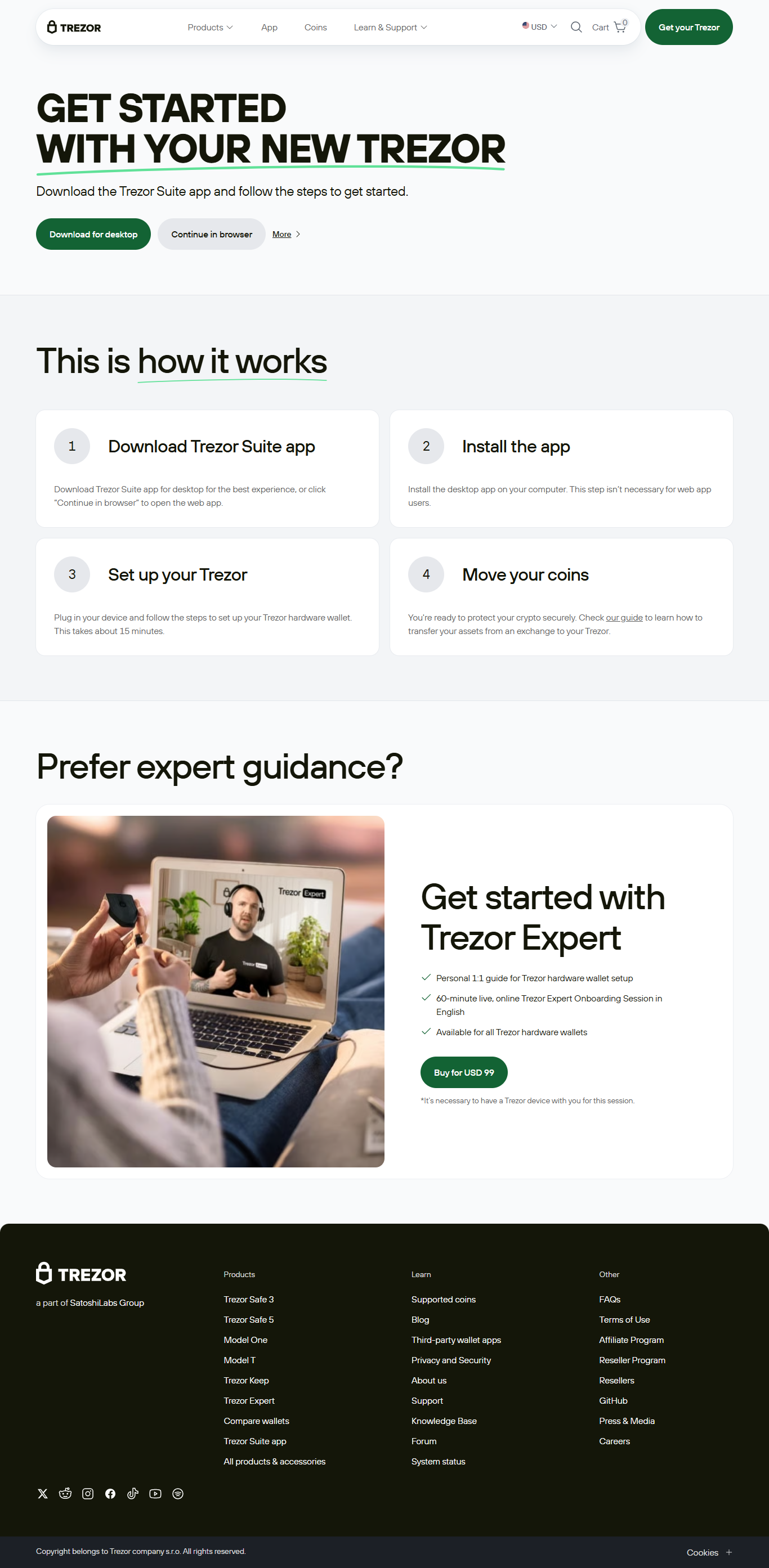
trezor.io/start Login – Official Trezor® Setup & Quickstart Guide
Introduction
If you're new to cryptocurrency and want to start managing your digital assets with confidence, this guide is designed for you. We’ll walk you through how to create and secure an account via trezor.io/start, how to download the app, complete verification, enable security settings such as two-factor authentication (2FA), and prepare to buy or trade crypto safely. We’ll draw on real-life experience and best practices so you can proceed with trust and clarity.
Why Choose trezor.io/start?
The platform at trezor.io/start is the official onboarding portal from Trezor. It’s designed with a strong emphasis on security, reliability and user control. Because you’ll be handling your crypto wallet, protecting your private keys and securing your account matter a lot. By following this guide, you’ll ensure you’re relying on authentic sources, setting robust safeguards, and avoiding common pitfalls.
Step-by-Step Guide: Creating Your Account and Logging In
-
Visit the official start page. Open your browser and navigate to https://trezor.io/start. Confirm you’re on the genuine site (check the HTTPS lock and domain spelling) to avoid phishing risks.
-
Download the companion app. On the page, you’ll find links for the Trezor Suite (desktop, web or mobile). Click the appropriate download for your operating system and install it. :contentReference[oaicite:2]{index=2}
-
Connect your Trezor device. Once installed, plug in your hardware wallet device (for example, the Model One or Model T) and the app will detect it and guide you through initialization. :contentReference[oaicite:3]{index=3}
-
Install or update firmware. The app will prompt for firmware update if needed — this ensures your device is running the latest security patches. Do this through the official interface. :contentReference[oaicite:4]{index=4}
-
Create a new wallet or recover an existing one. Follow the on-screen prompts: choose “Create new wallet” (unless you’re restoring) and note the instructions about your recovery seed.
-
Secure your recovery seed. Your wallet will render a 12- or 24-word recovery phrase. Write this down on paper (or a more durable backup) and store it in a safe, offline location. Never take a photo of it, never store it digitally. Losing this seed may mean losing access to your crypto. :contentReference[oaicite:5]{index=5}
-
Set a strong PIN and optionally a passphrase. You’ll be asked to set a device PIN that you’ll use to unlock your wallet. For extra security, consider enabling a passphrase (hidden wallet) feature. :contentReference[oaicite:6]{index=6}
-
Log in and access your wallet. Each time you connect your device, open Trezor Suite, enter your PIN on the device, and approve transactions on the physical hardware. This is your login process to access balances, send or receive cryptocurrencies.
-
Fund and start trading. With your wallet secured and logged in, you’re now ready to receive crypto, view balances, or trade (depending on which services you use). Always begin with a small test transaction to confirm everything works as expected.
Securing Your Account & Wallet – Best Practices
Here’s how to reinforce your setup and protect your funds from unauthorized access or phishing attacks:
- Always access your wallet through official URLs (such as trezor.io/start or the Trezor Suite app). Fake websites are a common attack vector. :contentReference[oaicite:7]{index=7}
- Enable Two-Factor Authentication (2FA) where available – this could refer to linked accounts, email alerts or additional device authentication. While the hardware wallet itself uses your physical confirmation, any associated exchange or account should also use 2FA. (For reference: see features on another platform like Ledger at ledger.com/start) “ledger.com/start security settings”.
- Never share your recovery seed, PIN or passphrase with anyone – not Trezor support, not a friend. No legitimate support will ask you for these. :contentReference[oaicite:9]{index=9}
- Store your recovery seed offline in a secure environment – consider using fire-proof and waterproof backup materials for extra safety.
- Keep firmware and software (Trezor Suite) up to date. Updates include security fixes and new features. Do not install firmware from third-party sites. :contentReference[oaicite:10]{index=10}
- Use a dedicated computer or mobile device for crypto activities if possible; avoid public or untrusted systems to minimize risk of keylogging or malicious software.
- Before sending large amounts, perform a small test transaction – verify the address, confirm the amount and ensure everything works. Mistakes are irreversible.
About KYC & Trading
Although the hardware wallet setup process via trezor.io/start is primarily about securing your wallet, if you choose to link your wallet with an exchange or trading service, you may encounter KYC (Know Your Customer) verification steps. These may require uploading identity documents, proof of address, etc. Always use legitimate, regulated platforms and verify their security policy.
Once your wallet is secure and set up, you’re ready to buy, trade or receive cryptocurrencies. As a beginner, consider:
- Start with familiar coins (Bitcoin, Ethereum) before exploring more complex tokens.
- Diversify holdings – don’t put all funds into one asset.
- Monitor your holdings periodically and remain informed about security practices.
Common Mistakes to Avoid
- Using unofficial download links or browser extensions pretending to be “Trezor Suite”.
- Storing the recovery seed digitally (cloud, photo, email) – this severely weakens security.
- Skipping firmware updates or ignoring device alerts.
- Assuming your wallet is “set and forget” – treat it like an important account with periodic checks.
FAQ
- Q: How do I create an account via trezor.io/start?
- A: Visit trezor.io/start, download the Trezor Suite software, connect your hardware wallet, install firmware, initialize a new wallet, set a PIN and secure your recovery seed. Once completed, you log in using your device and PIN.
- Q: Where do I find the trezor.io/start sign up option?
- A: There is no “sign up” like a traditional web account — the process is tied to your hardware device. By initializing your device via trezor.io/start, you effectively create your wallet access. Logging in happens via the Trezor device + PIN combination.
- Q: Does trezor.io/start require KYC verification?
- A: The hardware wallet setup via trezor.io/start itself does *not* require KYC. However, if you link your wallet to a trading or exchange service to buy/sell crypto, that service may require KYC depending on regulations and jurisdiction.
- Q: How do I download the app for trezor.io/start?
- A: On trezor.io/start you will see download links for Trezor Suite (desktop: macOS/Windows/Linux; mobile: iOS/Android). Click the correct link, install it, then connect your hardware wallet. :contentReference[oaicite:11]{index=11}
- Q: How do I enable two-factor authentication or extra security for my wallet created via trezor.io/start?
- A: The hardware wallet setup gives very high security already (your keys stay offline). For any linked accounts or trading platforms, enable 2FA (for example via an authenticator app). Additionally, you can enable a passphrase on your Trezor device to create a hidden wallet, adding another protection layer. :contentReference[oaicite:12]{index=12}
- Q: What happens if I lose or forget my PIN for the wallet created via trezor.io/start?
- A: If you forget your PIN, you can still restore your funds on a new device using your recovery seed. However, if you also lose your recovery seed, you will lose access to your crypto permanently. Store your seed securely at setup. :contentReference[oaicite:13]{index=13}
Conclusion
Getting started with crypto doesn’t have to be intimidating. By using the official portal at trezor.io/start, downloading the correct app, setting up your hardware wallet securely, and applying strong security practices, you’ll place yourself in a strong position to manage, trade and grow your digital assets with trust. Remember: your security is your responsibility. Treat your device, recovery seed and account like valuables. With that mindset, you’re well-on your way to a safe and productive crypto journey.